How to choose a PLA filament supplier
If you are buying filament to resell, the questions that matter are different from the ones a hobbyist asks. This guide covers the checks that separate a supplier you can reorder from — and the questions to ask before you place your first order.
Diameter tolerance: what the numbers mean
Filament is sold as 1.75 mm, but no extrusion run is perfectly round. When the diameter drifts thicker or thinner than nominal, the extruder is forced to over- or under-extrude — which shows up as inconsistent layers, surface defects, and in bad cases a clogged nozzle.
Suppliers quote tolerance in three common bands: ±0.05 mm is a typical entry-level spec, ±0.03 mm is tighter, and ±0.02 mm means the diameter stays within a band narrower than a human hair across the whole run. For a distributor, the tighter number is worth more than it looks: it is the difference between spools your customers print and forget, and spools that come back with complaints.
Ask for: continuous diameter measurement along the full length of every run — not a spot check on the first metres — plus ovality checked per batch.
Moisture control: the most common complaint
PLA absorbs moisture from the air. Wet filament pops and hisses at the nozzle, strings badly, and prints brittle — and most print failures that get blamed on the printer trace back to filament: diameter drift, moisture, or tangles. This is the single most frequent complaint a reseller will hear about filament.
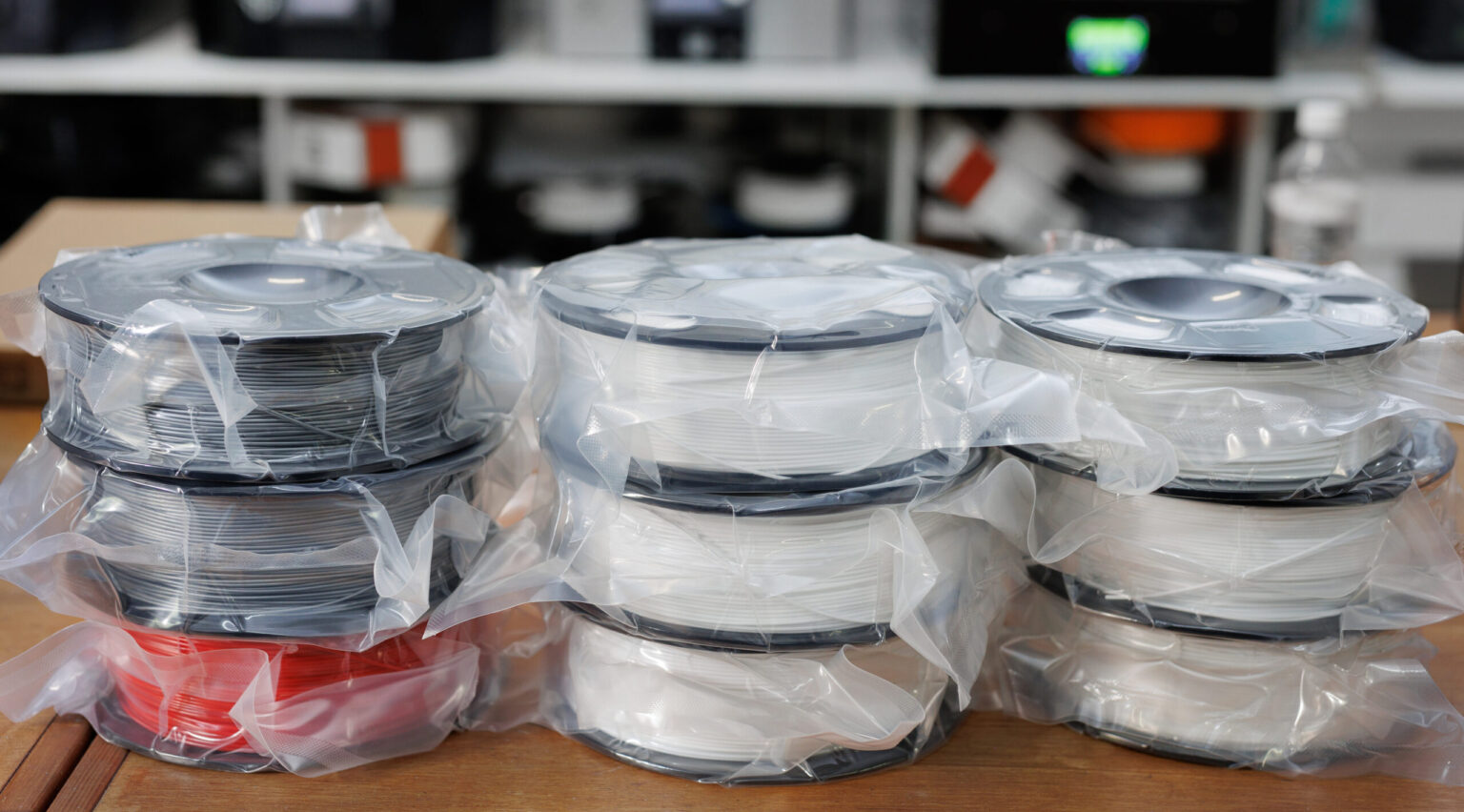
A supplier serious about moisture dries the spools and then vacuum-seals them with desiccant the same day, so the spool arrives at the moisture level it was packed at. Ask for: vacuum sealing with desiccant as standard, sealed promptly after drying — and a clear policy for spools that arrive with a broken seal.
Winding quality: the tangle test
Cross-overs and loose winding are the silent killers of unattended printing: the filament catches mid-print, the job fails overnight, and a print farm loses a shift. Good winding is not cosmetic — it is wound under controlled tension in a single ordered layer pattern, so the spool feeds tangle-free from the first metre to the last.
Ask for: a description of how spools are wound, and test a sample spool yourself by pulling several metres through your hand — you will feel a cross-over instantly.
Spool size and batch-to-batch consistency
A distributor ships by the carton, so predictable pack geometry matters: net weight per spool, spool dimensions, cartons per pallet. When one spool holds 1.5 kg and the next holds visibly less, your customers notice — and your freight maths breaks.
Colour is the other repeat-order risk. A black spool bought in March must print like the black spool bought in September: the same base resin, the same print window, and a batch code on every spool so any issue can be traced back to its production run.
Questions to ask any supplier
Send these six questions with any first enquiry. The quality of the answers tells you almost everything.
- Can I test sample spools of the actual production filament before ordering?
- How is diameter tolerance checked — continuously along every run, or by spot check?
- Is every spool vacuum-sealed with desiccant, and what is the carton spec?
- What happens if a spool arrives with a broken seal or a defect?
- Is each spool batch-coded, and do you keep retained samples?
- Can you match my procurement standard line by line?
How Wood Touch answers each point
These are the checks our own spools are held to — 1.75 mm PLA on 1.5 kg A2 spools, in ten stocked colours, for distributors, print farms, schools and resellers.
Diameter, watched continuously
Filament diameter is measured along the full length of every run, and any length outside ±0.02 mm never reaches a spool. Ovality is checked per batch.
Neat winding, no cross-overs
Spools are wound under controlled tension in a single ordered layer pattern, so filament feeds tangle-free from the first metre to the last.
Dried, then sealed the same day
Finished spools are dried and vacuum-sealed with desiccant immediately, so they arrive at the moisture level they were packed at. Re-seal with desiccant after opening; dry at 45 °C if a spool has absorbed moisture.
Batch traceability
Every spool carries its batch code. If a print farm reports an issue, we can trace the spool back to its production run and check retained samples.
Production samples
Sample spools are available on request — the same production filament as bulk orders, never a special batch.
Your standard, matched
If your procurement team works to its own standard, send it with your enquiry and we will match against it line by line. Quotes cover product, packing and freight options together.
Done with the checklist? Run it against us. Add the lines and colours you want to test in the enquiry builder, or sell the range under your own label with our OEM private label programme.